Science

Nov. 30th, 2025 12:58 am
ysabetwordsmith: Cartoon of me in Wordsmith persona (Default)
[personal profile] ysabetwordsmith
Generations of Bearded Vultures Stashed Humans’ Treasures, Including a 650-Year-Old Sandal, in These Bird Nests

Bearded vultures are unusual birds. Their diet consists primarily of bones, which they sometimes drop from great heights to break into smaller, bite-size pieces. They deliberately change the color of their plumage by rolling around in reddish-orange mud. And they return to the same nesting sites year after year, with generations of the species even reusing nests for centuries.

Read more... )
ysabetwordsmith: Cartoon of me in Wordsmith persona (Default)
[personal profile] ysabetwordsmith
'The Lord of the Rings' director Peter Jackson is on a mission to revive the world’s tallest bird, 600 years after it went extinct

Inspired by their debut project, Jackson is now working with Colossal to bring the ancient moa back to life through subfossil sourcing and genetic engineering.

On July 8, Jackson and his partner donated $15 million to the project
.


The moa is an excellent choice for de-extinction, as it died out relatively recently and due to human misbehavior.

Read more... )
ysabetwordsmith: Cartoon of me in Wordsmith persona (Default)
[personal profile] ysabetwordsmith
From dinosaurs to birds: the origins of feather formation

Scientists reveal the key role of specific genes in feather development, providing insights into their evolution from dinosaurs.
Feathers, essential for thermoregulation, flight, and communication in birds, originate from simple appendages known as proto-feathers, which were present in certain dinosaurs.By studying embryonic development of the chicken, researchers from the University of Geneva (UNIGE) have uncovered a key role of a molecular signalling pathway (the Shh pathway) in their formation. This research provides new insights into the morphogenetic mechanisms that led to feather diversification throughout evolution

Fossils

Feb. 8th, 2025 04:12 pm
ysabetwordsmith: Cartoon of me in Wordsmith persona (Default)
[personal profile] ysabetwordsmith
Cretaceous fossil from Antarctica reveals earliest modern bird

Sixty-six million years ago, at the end of the Cretaceous Period, an asteroid impact near the Yucat n Peninsula of Mexico triggered the extinction of all known non-bird dinosaurs. But for the early ancestors of today's waterfowl, surviving that mass extinction event was like ... water off a duck's back. Location matters, as Antarctica may have served as a refuge, protected by its distance from the turmoil taking place elsewhere on the planet. Fossil evidence suggests a temperate climate with lush vegetation, possibly serving as an incubator for the earliest members of the group that now includes ducks and geese.
ysabetwordsmith: Cartoon of me in Wordsmith persona (Default)
[personal profile] ysabetwordsmith
Discovering the traits of extinct birds

Analysis of 216 extinct species by biologists found birds endemic to islands, occupied ecologically specific niche, lacking flight, with large bodies and sharply angled wings were the ones likely to disappear the soonest after 1500.


In other words, humans are lazy and hungry, also prone to bring pests.  :/

Dinosaurs

Nov. 15th, 2024 05:34 pm
ysabetwordsmith: Cartoon of me in Wordsmith persona (Default)
[personal profile] ysabetwordsmith
Bird brain from the age of dinosaurs reveals roots of avian intelligence

A 'one of a kind' fossil discovery could transform our understanding of how the unique brains and intelligence of modern birds evolved, one of the most enduring mysteries of vertebrate evolution.


Bird brains are surprisingly complex, and pack more of a punch for their size, which leads mammalian scientists to underestimate avian intelligence. Anyone who has tried to keep birds from peeling the foil off milk bottles, or keep big greedy birds from eating all the food meant for smaller songbirds, knows how smart the little bastards are. I've seen sparrows figure out how to snatch a bite of suet or thistle from an upside-down feeder!
ysabetwordsmith: Cartoon of me in Wordsmith persona (Default)
[personal profile] ysabetwordsmith
Fossil of huge terror bird offers new information about wildlife in South America 12 million years ago

Evolutionary biologists report they have analyzed a fossil of an extinct giant meat-eating bird -- which they say could be the largest known member of its kind -- providing new information about animal life in northern South America millions of years ago.
[---8<---]
The bone, found in the fossil-rich Tatacoa Desert in Colombia, which sits at the northern tip of South America, is believed to be the northernmost evidence of the bird in South America thus far.

The size of the bone also indicates that this terror bird may be the largest known member of the species identified to date, approximately 5%-20% larger than known Phorusrhacids, Cooke says. Previously discovered fossils indicate that terror bird species ranged in size from 3 feet to 9 feet tall.


I love terror birds. I mean, I'm glad they aren't around herenow, but they really are awesome. It's like they missed the memo that they weren't supposed to be big scary dinosaurs anymore.
futurejake: Illustration of a smiling white person with short brown hair, round glasses, and vitiligo patches. (Default)
[personal profile] futurejake

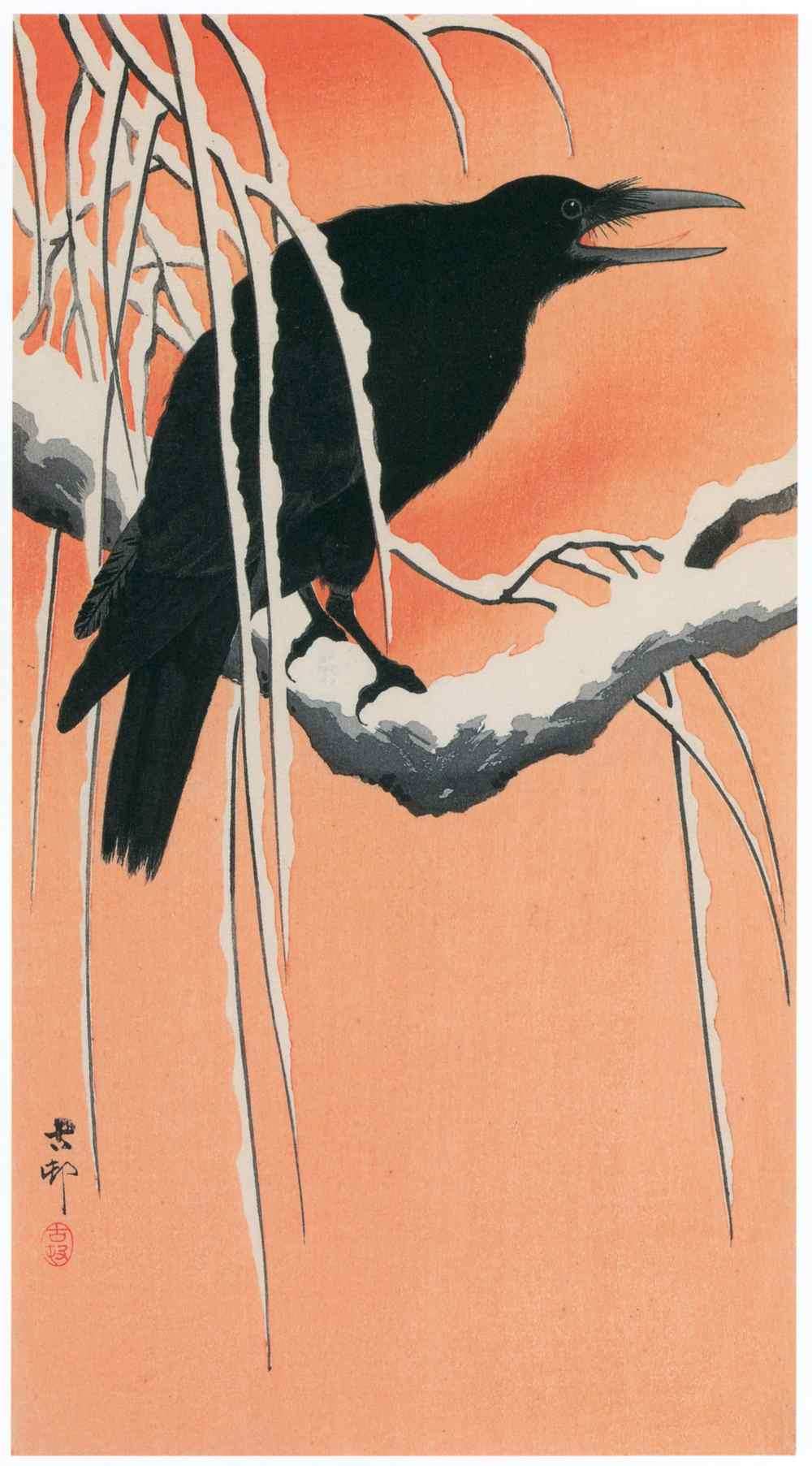
Hi everyone! I'm new here. At [personal profile] ysabetwordsmith's suggestion, I've come to share these beautiful woodblock prints by kachō-e artist Ohara Koson. According to Ronin Gallery, the first print is from around 1910, and the second is from around 1912. They are in the public domain, so feel free to share around!

Woodblock print of a cawing crow on a snowy branch.

Woodblock print of a crow on a blossoming branch.

batiferrite: (Default)
[personal profile] batiferrite
I went to a bookstore in a library and found some really cool books about birds, including Birds of an Iowa Dooryard by Althea R. Sherman. I haven't read all of her essays yet, but I'd really  recommend "Down with the House Wren Boxes" (1925). You can read a pdf here.

I just thought it was really interesting and funny how she starts off talking about how the House Wren is a Menace to Society and should be put to trial for his Crimes... but people are biased due to his cuteness and would never hold him accountable.

You can find other old birding magazines online, like Bird-Lore, which has a mixture of scientific articles, personal experiences, questions, how to engage the youth, and some good old fashioned bird discourse, as well. I just think it's really interesting to read through and see that people circa 1899 were basically forming the same sorts of communities like we do today! 

Profile

birdfeeding: A bird singing (Default)
Birdfeeding: Friends of a Feather Flock Together

January 2026

S M T W T F S
     1 2 3
4 5678910
11121314151617
18192021222324
25262728293031

Syndicate

RSS Atom

Most Popular Tags

Style Credit

Expand Cut Tags

No cut tags